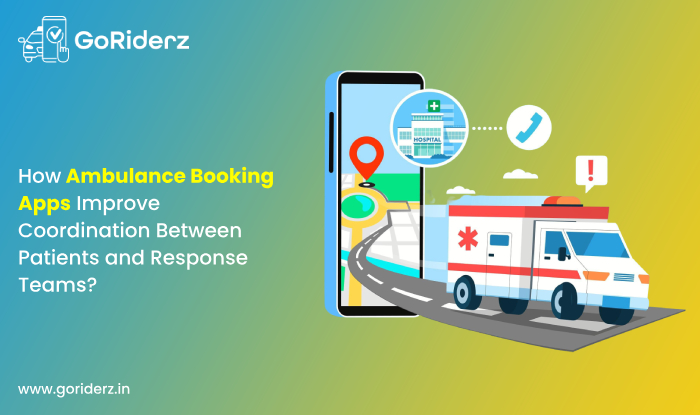
How Ambulance Booking Apps Improve Coordination Between Patients and Response Teams?
Table of Contents
Ambulance booking apps improve coordination by directly connecting patients, ambulance teams, and hospitals on one digital platform. The moment a request is raised, all parties receive the same information at the same time. This removes confusion and reduces delays.
In ambulance booking app development, the main goal is to create fast communication between patients and response teams. These apps focus on real-time updates, clear location sharing, and early access to patient details.
By 2026, the global ambulance services market is expected to cross $50 billion, according to Global Market Insights. This growth shows the rising need for quicker and better-organized emergency response systems.
What Are Ambulance Booking Apps?
Global ambulance services market to reach over $50 billion by 2026 (Global Market Insights). Ambulance booking apps allow people to request emergency or non-emergency ambulances using a smartphone. These apps replace long phone calls with a direct digital request system.
Patients enter basic details such as their location, type of emergency, and symptoms. Once submitted, nearby response teams receive instant alerts. Hospitals also get notified so they can prepare in advance.
Emergency ambulance booking app development often includes GPS-based location tracking to guide teams accurately to the patient.
How Do These Apps Work?
The working process follows a clear and connected flow that keeps everyone informed.
A user opens the app during an emergency and selects the type of service needed. The app then identifies the nearest available ambulance using location data. Response teams receive the request and accept it with one tap.
Once accepted, the ambulance starts moving toward the patient. The app shows live updates, including estimated arrival time. This single loop keeps patients, teams, and hospitals aligned throughout the process.
How Do They Improve Coordination?
Traditional emergency calls depend on verbal explanations, which often lead to delays or wrong directions. Ambulance booking apps remove this gap by sharing exact locations digitally.
Response teams receive patient details before reaching the site. This allows them to carry the right medical tools and prepare for the situation. Patients can see where the ambulance is, which reduces stress during emergencies.
Hospitals receive early alerts and patient information. This helps staff arrange beds, equipment, and doctors before arrival. Overall, coordination improves because everyone works with the same data in real time.
What Are The Key Features That Boost Coordination?
These apps include features that support smooth coordination between all parties.
- Real-time tracking: Patients and hospitals can see the ambulance location live on a map.
- Instant messaging: Patients and teams can communicate without phone calls.
- Medical history sharing: Prior health details help teams prepare early.
- Automated dispatch: Requests go to the closest available ambulance.
- Hospital integration: Patient data reaches hospitals before arrival.
These features are a core part of modern emergency ambulance booking app development.
What Trends Are Shaping These Apps in 2026?
Ambulance booking services app development continues to grow with new system upgrades that support faster response.
AI tools help predict peak emergency hours so teams can be placed where demand is higher. Voice-based requests allow users to book ambulances without typing. Wearable devices now share health data like heart rate directly with response teams.
Many service providers are adding hybrid vehicle fleets to reduce fuel costs. Remote doctor support through video calls also helps guide ambulance teams during transit.
The global ambulance market is expected to grow at over 6% CAGR from 2026 to 2035 (Research Nester).
Conclusion
Ambulance booking apps have changed how emergency services operate. They connect patients, response teams, and hospitals on one system with shared information.
With real-time tracking, early alerts, and direct communication, coordination becomes faster and clearer. As features like AI support and telehealth grow, these apps will continue to improve emergency response outcomes.
Emergency ambulance booking app development plays a major role in saving time and supporting better medical care.
FAQs
1. What is the average cost to develop an ambulance booking app?
The cost usually ranges between $50,000 and $150,000, based on features and platform choice. Costs may increase if advanced tracking, hospital systems, or telehealth support are added.
2. Which are the top ambulance booking apps available in 2026?
Popular options include LifeLine EMS, WeCare, and several city-based services across the USA. Availability often depends on regional partnerships and local emergency networks.
3. How long does it take to build an ambulance booking app?
Development generally takes 3 to 6 months, including planning, testing, and launch. The timeline depends on app complexity and required system integrations.
4. What technologies power these apps?
Common technologies include React Native for apps, Node.js for backend systems, and Google Maps API for location tracking. Healthcare data security tools are also used to protect patient information.
5. How to pick a company for app development?
Look for experience in healthcare projects, check past work, and review client feedback before making a decision. Clear communication and post-launch support also matter for long-term success.